

Office No 204, Second Floor, Garg Complex, Guru Nanakpur Gali No 3, Near Nirman Vihar Metro Station (V3S Mall), Delhi – 110092.

Our Blog
Best Criminal Lawyer in Delhi | Best Divorce Lawyer in Delhi | Advocate Nidhi Rajoura
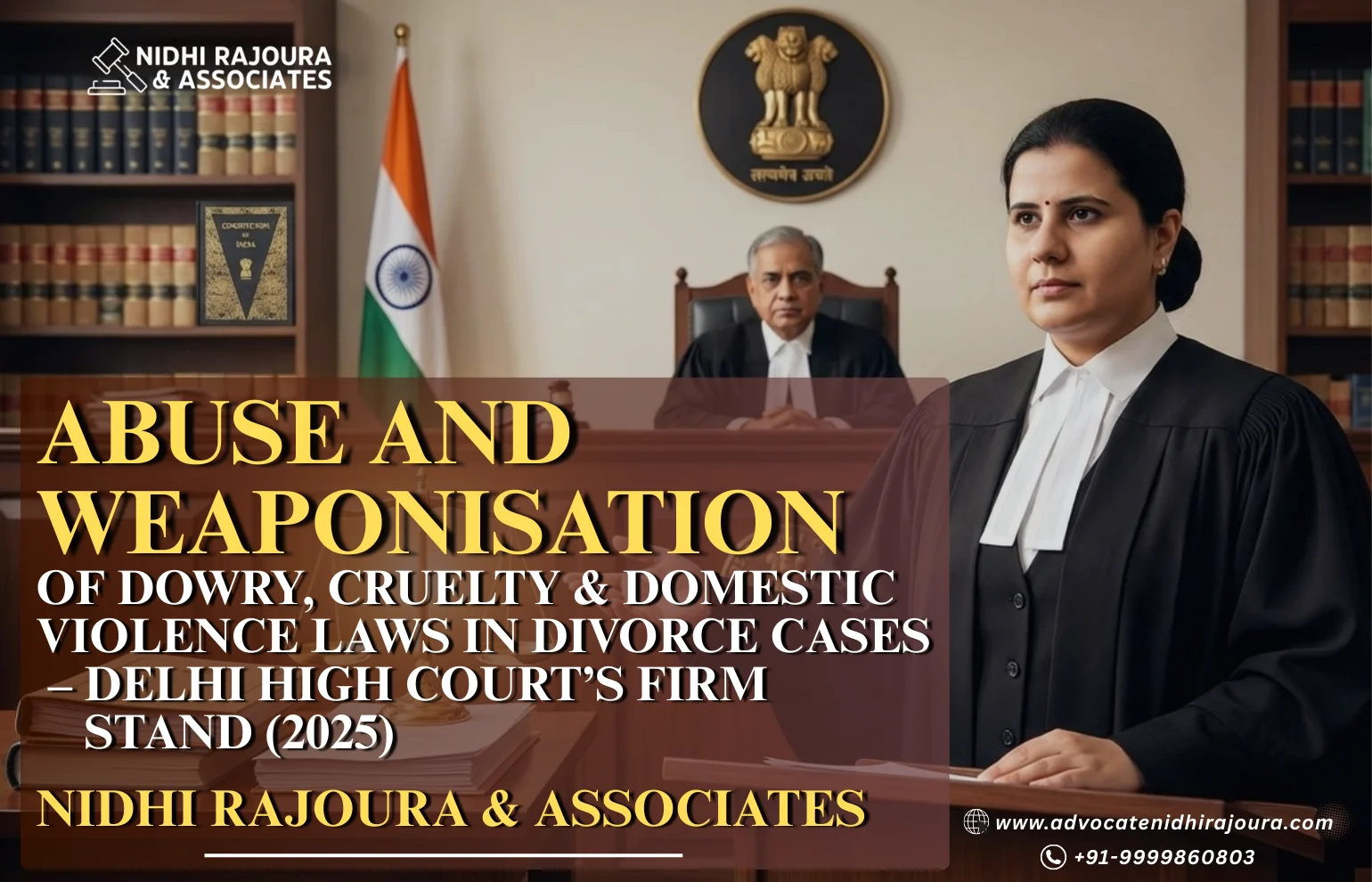
Abuse and Weaponisation of Dowry, Cruelty & Domestic Violence Laws in Divorce Cases
Introduction - Best Divorce Lawyer in Delhi HC on Abuse of Matrimonial Laws
In recent years, matrimonial disputes in India—particularly in Delhi—have witnessed a growing trend of abuse, exploitation, and weaponisation of matrimonial criminal laws. Provisions such as Section 498A IPC, the Dowry Prohibition Act, and the Protection of Women from Domestic Violence Act, 2005, though enacted as protective legislations, are increasingly being invoked in a malicious and exaggerated manner during divorce proceedings.
The Delhi High Court, through consistent judicial pronouncements till 2025, has categorically held that criminal law cannot be permitted to become an instrument of harassment, coercion, or extortion in matrimonial conflicts.
At Nidhi Rajoura & Associates, recognised as one of the best divorce and criminal law firms in Delhi High Court, we regularly defend clients against such abusive invocation of criminal proceedings.
Read Also - Related Links
Justice For The Wrongfully Accused In False 498a, Dowry & Domestic Violence Cases
Common Matrimonial & Criminal Laws Subject to Abuse in Divorce Litigation
As experienced divorce lawyers in Delhi High Court, we frequently encounter the manipulation of the following legal provisions:
- Section 498A IPC – Cruelty by Husband or Relatives
- Domestic Violence Act, 2005
- Dowry Prohibition Act
- Section 406 IPC – Criminal Breach of Trust
- Maintenance and Alimony Proceedings as Pressure Mechanisms
The Delhi High Court has clarified that every matrimonial disagreement cannot be criminalised by the mechanical application of penal provisions.
What Constitutes Cruelty Under Section 498A IPC? – Delhi High Court Interpretation
The courts have consistently ruled that cruelty must be serious, specific, and supported by cogent evidence.
Legal Requirements
- Clear attribution of role
- Specific incidents with dates and conduct
- Continuous and grave mental or physical cruelty
Not Considered Cruelty
- Normal marital wear and tear
- Ordinary arguments and incompatibility
- Financial disagreements
- Filing of divorce or living separately
Delhi High Court
“The unwarranted criminalisation of routine matrimonial discord amounts to abuse of the process of law.”
Vague and Omnibus Allegations – Hallmark of Malicious Prosecution
One of the strongest grounds for FIR quashing in matrimonial cases before Delhi High Court is the presence of vague, omnibus, and generalized allegations.
Courts strongly disapprove
- Identical allegations against all family members
- No distinct role assigned to in-laws
- Implication of distant relatives living separately
- Allegations unsupported by medical or documentary evidence
Such complaints are treated as malicious prosecution and abuse of criminal law, warranting quashing under Section 482 CrPC.
Delayed Complaints – Indicative of Afterthought and Legal Manipulation
Where criminal complaints are filed:
- After years of separation
- Only after receipt of divorce notice
- Without prior complaints or evidence
Delhi High Court views such delayed invocation of criminal law as a clear afterthought and exploitation of statutory provisions.
Domestic Violence Act: Protective Law or Instrument of Coercion?
While the DV Act is a beneficial statute, courts have clarified that:
- It cannot be distorted into a recovery mechanism
- Right to residence is not absolute
- Ex-parte relief requires strict judicial caution
- False and frivolous DV complaints invite dismissal
The Delhi High Court has repeatedly condemned the weaponisation of the Domestic Violence Act in matrimonial disputes.
Anticipatory Bail in Matrimonial Criminal Cases – Delhi High Court Protection
In cases involving abusive invocation of Section 498A and DV Act, Delhi High Court follows settled principles:
- No automatic arrest
- Arrest only when legally necessary
- Protection to elderly parents and women relatives
- Mechanical arrests declared illegal
As best criminal lawyers in Delhi, we routinely secure anticipatory bail where allegations appear exaggerated or malicious.
Quashing of False FIRs – Inherent Powers of Delhi High Court
The Delhi High Court exercises inherent jurisdiction under Section 482 CrPC to:
- Prevent abuse of legal process
- Secure ends of justice
- Curb malicious matrimonial litigation
FIRs are quashed where
- Allegations lack substance
- Criminal law is exploited for pressure
- Settlement has taken place
- Continuation of proceedings amounts to harassment
Maintenance & Alimony – Not a Tool for Enrichment
Recent Delhi High Court rulings reaffirm that:
- Maintenance is not automatic
- Financially independent or capable wives cannot exploit maintenance provisions
- False income affidavits attract strict consequences
“Maintenance is a measure of support, not a means of unjust enrichment.”
Strategic Defence Against Abusive Matrimonial Litigation
An effective legal defence requires:
- Coordinated handling of divorce and criminal cases
- Early anticipatory bail
- FIR quashing strategy
- Financial and documentary evidence
- Exposure of contradictions across proceedings
Such strategy demands representation by experienced divorce and criminal lawyers in Delhi High Court.
Why Choose Nidhi Rajoura & Associates – Best Divorce & Criminal Lawyer in Delhi High Court
- Regular practice before Delhi High Court & Family Courts
- Expertise in Divorce, 498A IPC, DV Act, Anticipatory Bail & FIR Quashing
- Strong drafting, evidence-based arguments
- Confidential, ethical, and client-focused approach
- Proven success against abusive matrimonial prosecutions
Conclusion: Delhi High Court on Abuse of Matrimonial Criminal Laws
The Delhi High Court has sent a clear message:
- Protective laws cannot be distorted into tools of harassment
- Abusive and malicious prosecution in matrimonial disputes will not survive judicial scrutiny
If you are facing false dowry allegations, abusive 498A cases, or weaponised domestic violence complaints, early legal consultation is crucial. Contact Nidhi Rajoura & Associates - Best Divorce & Criminal Lawyer in Delhi High Court & Trial Courts.
For expert legal advice on divorce, maintenance, alimony, or matrimonial criminal disputes, consult Nidhi Rajoura and Associates – Best Divorce & Criminal Lawyers in Delhi.
Disclaimer: This article is for informational purposes only and does not constitute legal advice. Each case depends on its own facts, evidence, and judicial discretion. Readers are advised to consult with us for accurate guidance.
FAQs
1. What is meant by abuse or weaponisation of matrimonial laws?
Abuse or weaponisation of matrimonial laws refers to the malicious or exaggerated invocation of legal provisions such as Section 498A IPC, the Dowry Prohibition Act, and the Domestic Violence Act during divorce or marital disputes. Courts have observed that these laws are sometimes used as tools of coercion, harassment, or monetary pressure rather than for genuine protection, which amounts to abuse of the legal process.
2. Does every marital dispute amount to cruelty under Section 498A IPC?
No. The Delhi High Court has consistently clarified that normal wear and tear of marriage, routine arguments, financial disagreements, or incompatibility do not constitute cruelty. For an offence under Section 498A IPC, cruelty must be serious, continuous, specific, and supported by credible evidence. Vague or generalized allegations are insufficient to sustain criminal proceedings.
3. Can false dowry harassment or cruelty cases be quashed by the Delhi High Court?
Yes. The Delhi High Court has the power to quash false or malicious FIRs under Section 482 CrPC where allegations are vague, unsupported by evidence, filed with ulterior motives, or amount to abuse of criminal law. Courts routinely intervene to prevent harassment of innocent husbands and their family members.
4. Are parents and relatives of the husband protected from false matrimonial cases?
Yes. Courts strongly disapprove of the indiscriminate implication of elderly parents, sisters, or distant relatives living separately. If no specific role or overt act is attributed to such relatives, proceedings against them are often quashed, and protection from arrest is granted.
5. Is arrest automatic in Section 498A or Domestic Violence cases?
No. As per settled law and Delhi High Court guidelines, automatic arrest is illegal. Arrest must be justified by necessity, and courts regularly grant anticipatory bail where allegations appear exaggerated, doubtful, or motivated. Protection of personal liberty is a fundamental principle upheld by the judiciary.
6. Can the Domestic Violence Act be used to claim money or property unfairly?
The Domestic Violence Act is a protective statute, not a recovery mechanism. The Delhi High Court has clarified that the Act cannot be distorted for unjust financial gain. Ex-parte orders are passed cautiously, and false or frivolous complaints can be dismissed with costs.
7. Does delay in filing a 498A or domestic violence complaint affect the case?
Yes. Unexplained delay in lodging criminal complaints is viewed seriously by courts. If parties lived separately for long periods and complaints are filed only after divorce proceedings begin, such conduct is often treated as an afterthought and an exploitation of legal provisions.
8. Is maintenance or alimony an automatic right for the wife?
No. Maintenance is not automatic and is not meant to be a source of unjust enrichment. Courts have held that an educated, earning, or capable spouse cannot claim unreasonable maintenance. Suppression of income or filing false affidavits can lead to dismissal of maintenance claims.
9. How can a husband defend against abusive matrimonial litigation?
An effective defence involves timely anticipatory bail, FIR quashing petitions, coordinated handling of divorce and criminal proceedings, financial disclosures, and documentary evidence. A strategic, evidence-based approach is essential to counter malicious prosecution in matrimonial disputes.
10. Why should one consult an experienced divorce and criminal lawyer in Delhi High Court?
Matrimonial disputes involving criminal allegations require specialised expertise in both divorce and criminal law. An experienced lawyer ensures protection from arrest, proper legal strategy, effective drafting, and strong representation before the Delhi High Court and Family Courts, safeguarding liberty, reputation, and legal rights.
Best Divorce Lawyer in Delhi | Best Matrimonial Lawyer in Delhi
Best Family Lawyer in Delhi | Best Child Custody Lawyer in Delhi