


Office No 204, Second Floor, Garg Complex, Guru Nanakpur Gali No 3, Near Nirman Vihar Metro Station (V3S Mall), Delhi – 110092.

Our Blog
Best Criminal Lawyer in Delhi | Best Divorce Lawyer in Delhi | Advocate Nidhi Rajoura
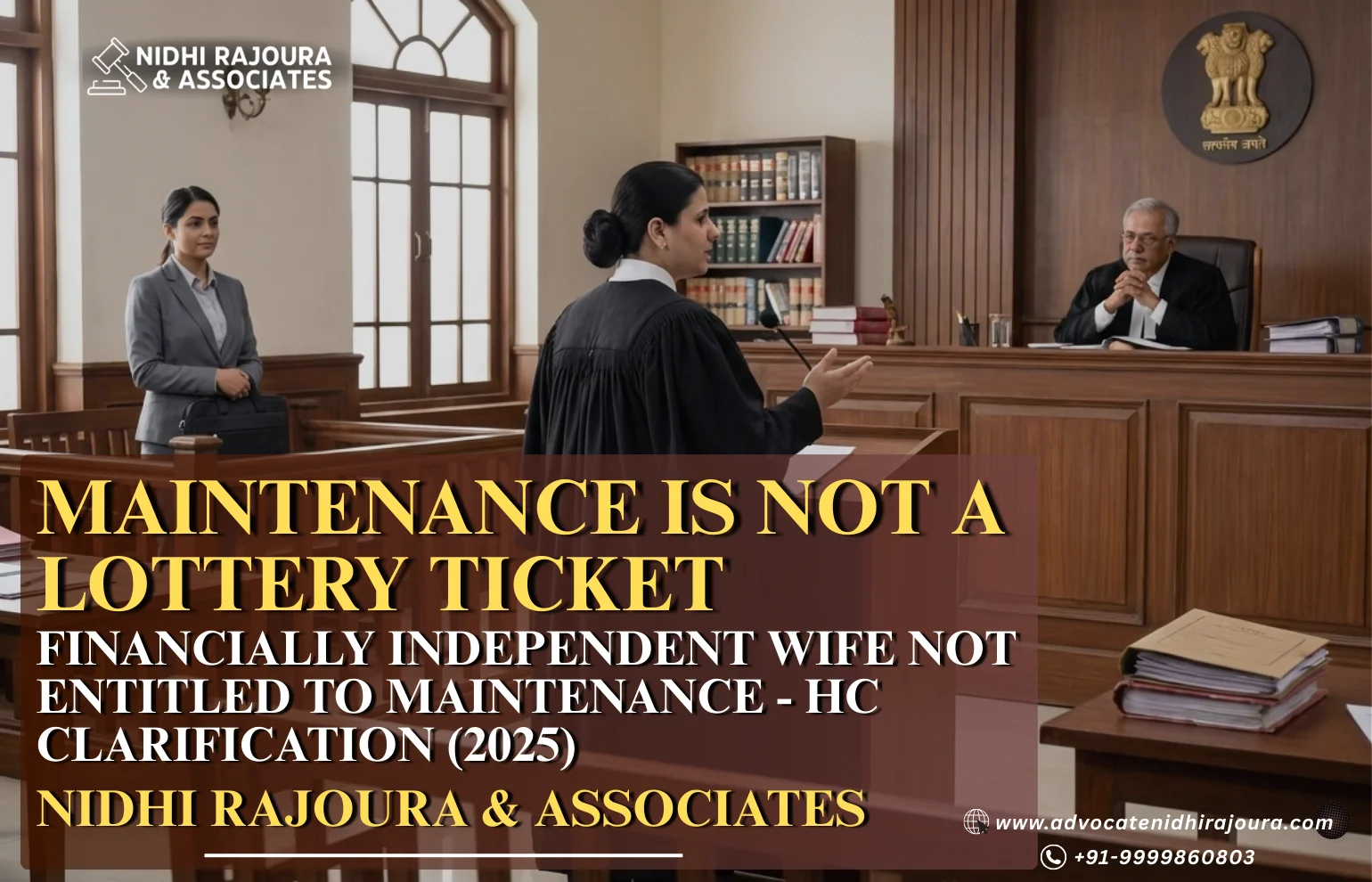
Maintenance Is Not a Lottery Ticket - Financially Independent Wife Not Entitled to Maintenance - HC Clarification (2025)
Introduction
In 2025, the Delhi High Court has once again reiterated a critical principle of matrimonial law in India: maintenance and alimony are not automatic entitlements flowing from marriage. The Court categorically clarified that a wife who is financially independent, educated, professionally qualified, or capable of earning cannot claim maintenance merely because matrimonial litigation is pending. This clarification comes at a time when maintenance proceedings under Section 125 CrPC, Section 24 & 25 of the Hindu Marriage Act, and the Protection of Women from Domestic Violence Act, 2005 are frequently used as pressure tactics in contested divorce and criminal matrimonial disputes, including false cases under Section 498A IPC.
Read Also - Related Links
Divorce Rights for Women in India and How to File Divorce & Claim Alimony
Justice For The Wrongfully Accused In False 498a, Dowry & Domestic Violence Cases
Maintenance Is a Measure of Support, Not a Windfall
Indian courts have consistently held that the object of maintenance laws is to prevent destitution and vagrancy, not to provide a comfortable or luxurious lifestyle to an able-bodied and qualified spouse at the cost of the other.
In 2025, Delhi High Court benches reiterated that:
“Maintenance is meant to provide necessary support to a spouse who is unable to maintain herself, not to reward idleness or penalise the earning spouse.”
Courts have strongly deprecated the tendency to treat maintenance as a “lottery ticket” or assured monthly income, especially where the wife is deliberately suppressing her qualifications, income, or earning potential.
Financially Independent or Earning-Capable Wife: No Automatic Maintenance
The Delhi High Court has clarified that actual income is not the sole test. Even if a wife claims to be unemployed, the Court will examine:
- Educational qualifications
- Professional degrees or work experience
- Previous employment history
- Age, health, and employability
- Lifestyle before and after marriage
If the wife is found to be capable of earning, courts have refused maintenance outright or substantially reduced the amount.
Key Judicial Observations
- A well-qualified wife cannot sit idle and demand maintenance.
- Deliberate unemployment is not a ground for claiming maintenance.
- Courts can impute income based on qualifications and experience.
- Maintenance cannot be used as leverage in divorce or criminal cases.
Landmark Judgments Reinforced in 2025
- Mamta Jaiswal v. Rajesh Jaiswal (MP HC) - The Court held that an educated wife capable of earning cannot claim maintenance as a matter of right.
- Kanchan v. Kamalendra (Delhi HC) - Maintenance was denied where the wife had sufficient qualifications and earning potential but chose not to work.
- Shailja v. Khobbanna (Supreme Court) - The Supreme Court clarified that capability to earn is a relevant factor, not merely present employment.
Recent Delhi High Court Orders (2024–2025) Delhi High Court consistently observed that maintenance provisions are being misused alongside false 498A IPC, DV Act, and criminal complaints to harass husbands and their families.
Maintenance, Divorce & Criminal Cases: The Overlapping Reality
In practice, maintenance claims are rarely standalone. They are often accompanied by:
- Section 498A IPC (Cruelty & Dowry Harassment)
- Domestic Violence Act complaints
- Stridhan recovery proceedings
- Contested divorce petitions
Courts have acknowledged that bundling of civil and criminal proceedings is frequently done to exert psychological and financial pressure. This evolving legal position has significantly increased the demand for law firms that specialise in both divorce and criminal matrimonial litigation.
Why Expert Legal Representation Matters
Handling maintenance disputes today requires strategic financial disclosure, cross-examination skills, and knowledge of criminal defence, especially where false allegations are involved.
As best divorce and criminal lawyers in Delhi, Nidhi Rajoura and Associates regularly represent clients in:
- False and inflated maintenance claims
- Financial suppression and misrepresentation cases
- Overlapping DV, 498A, and maintenance proceedings
- Appeals before the Delhi High Court
- Modification and cancellation of maintenance orders
The firm is widely recognised for its balanced, ethical, and evidence-driven approach to matrimonial disputes.
Conclusion
The 2025 Delhi High Court clarification sends a strong message. Marriage does not create a lifelong financial entitlement. Maintenance is need-based, not gender-based or litigation-based. Capable and qualified spouses must contribute to their own sustenance. This progressive judicial trend protects the sanctity of matrimonial law while discouraging its misuse.
For expert legal advice on divorce, maintenance, alimony, or matrimonial criminal disputes, consult Nidhi Rajoura and Associates – Best Divorce & Criminal Lawyers in Delhi.
Disclaimer: This article is for informational purposes only and does not constitute legal advice. Each case depends on its own facts, evidence, and judicial discretion. Readers are advised to consult with us for accurate guidance.
FAQs
1. Is maintenance automatic for a wife after filing a divorce case?
No. Maintenance is not automatic. The court examines income, qualifications, earning capacity, and conduct of both parties.
2. Can a qualified but unemployed wife claim maintenance?
Courts may deny or reduce maintenance if the wife is qualified and capable of earning but chooses not to work deliberately.
3. Does pendency of a 498A or DV case guarantee maintenance?
No. Criminal proceedings do not automatically entitle a wife to maintenance. Each case is assessed independently.
4. Can maintenance be cancelled later?
Yes. Maintenance can be modified or cancelled if there is a change in circumstances or if suppression of income is proved.
5. Can the court assume income if the wife hides her earnings?
Yes. Courts can impute income based on qualifications, past employment, and lifestyle.
6. Why hire a lawyer experienced in both divorce and criminal law?
Because maintenance disputes often overlap with criminal cases, requiring coordinated defence strategy across multiple courts.
Best Divorce Lawyer in Delhi | Best Matrimonial Lawyer in Delhi
Best Family Lawyer in Delhi | Best Child Custody Lawyer in Delhi